
Not a Portfolio. A Presence.
This wasn’t really about building a website. It was about translating a way of seeing into something you can scroll through without breaking it.
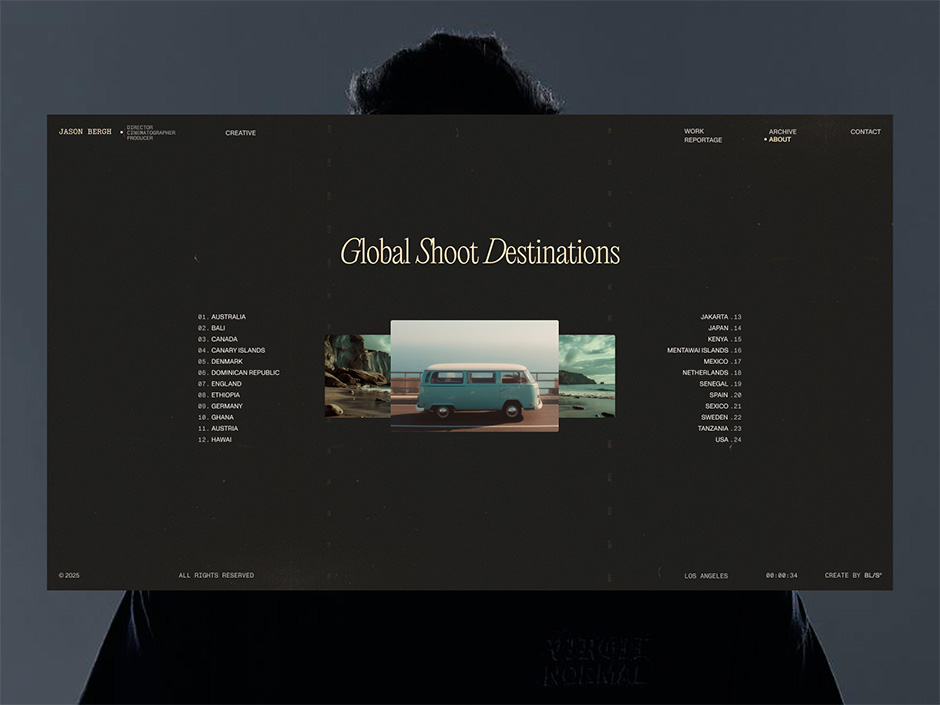
This wasn’t really about building a website. It was about translating a way of seeing into something you can scroll through without breaking it.
Jason Bergh doesn’t think in pages, menus, or structured user flows. His work lives in scenes, in rhythm, in tension and release. So from the very beginning, the idea of creating a conventional portfolio felt slightly misplaced — like trying to frame something cinematic inside a static grid.
A Director, Not a Website Owner
Jason already had a website, and technically, it did everything it was supposed to do. It presented projects, gave context, and followed familiar patterns. But it didn’t quite reflect the way he sees and constructs his work.
And that became the real starting point.
Because when your medium is emotion and pacing, a traditional interface can easily become noise. Too many signals, too many instructions, too many layers explaining themselves. The more we looked at it, the clearer it became that improving the existing structure wouldn’t solve the problem.
“We had to step away from the idea of structure altogether and rethink what a digital presence for a director could feel like.”
Three patterns that scale
Most websites are built to guide, inform, and direct attention as clearly as possible. Here, we were more interested in what happens when you remove that layer almost entirely.
Instead of adding features or refining navigation, we started subtracting. Menus became less visible, then unnecessary. Interface elements that explained how to use the site slowly disappeared. What remained was something much quieter, but also more intentional.
The idea was not to make things minimal for the sake of aesthetics, but to create space for the work to exist without interruption. When there’s less to process, there’s more room to feel.
At some point, it stopped feeling like an interface you operate and started behaving more like an environment you enter.
Motion as Narrative
Animation played a central role, but never as decoration. Every movement had to justify its existence.
We approached motion the same way editing is approached in film: when it works, you don’t notice it, but you feel its impact. When it doesn’t, it becomes distracting immediately. That meant constantly questioning whether something was helping the narrative or simply adding noise.
Over time, motion stopped being a layer on top of the interface and became the interface itself. It guides attention, sets pace, and creates continuity without relying on explicit instructions.